- Status
- Experiment New and still being tried. Expect rough edges.
- Its job
- Runs the business side, whatever you sell: a one-page plan, customers and invoices, money each month and the deadlines.
- In Grok
- The Office Manager Bot
- Before you add it
- It's free, it's new, and it runs on artificial intelligence. Check what it gives you; you make the decisions.
Your office manager for a small business: the plan, customers and invoices, the money each month, the company and its deadlines, and the meetings with lenders, investors and buyers. With an invention, it runs the business around it.
What it does
Runs a small business, whatever it sells: a one-page plan, customers and invoices, money each month, the company and its deadlines, funding, the website and promotion. For an inventor, also patent preparation, licensing and getting into stores.
Set it up in Grok
Add it from the ready-made bot.
- Open the Office Manager Bot template and add it to your Grok bots.
- Open the new bot. The first time, it installs the office on your account (a minute or two), then greets you.
- Say yes to the setup. It makes your project folder, connects your Google Drive (you sign in on a card it shows you) and checks that saving works. Then answer its questions, one at a time. If it ever goes quiet, ask "What's next?"
Tuned for you
Tuned for a small business starting out: one owner, little money, and many first-time conversations with customers, suppliers, bankers and investors. It works for a shop, a service, a trade or an invention. It prepares the paperwork so you can do it yourself on your own money, tells you when other people's money, a contract, the law or safety calls for an attorney, accountant or other professional, sends nothing without your yes, and leaves the signing and paying to you.
What it does for you
- A one-page business plan. Tell it about your business. It writes the plan on one page: what you sell, to whom, at what price, how customers find you, what it costs to run, break-even, and the one number to watch this month. Pricing for services as well as products. How it works
- Customers, quotes and invoices. Every possible sale with its next step and date, quotes that go out on time, numbered invoices, and a friendly reminder drafted when one is overdue. How it works
- Money each month. A short close at the start of each month: what came in, what went out, cash in the bank, how many months it lasts, and what's still owed to you. How it works
- A compliance calendar. Licenses, permits, annual reports, estimated and sales taxes for your state and town, each date traced to the agency's own page, with a reminder before it's due. How it works
- A weekly review. Ten minutes on your day each week: the one number, new customers and invoices, what slipped, what's due in the next two weeks, and the three things that matter next. How it works
- Contractors and first hires. Before you pay someone: the facts on contractor or employee laid out from the IRS and state sources, an agreement drafted from a checklist (who owns the drawings included), the tax forms, and the year-end and payroll dates. How it works
- Ready for your business meetings. Tell it who you're meeting. It works out what that person will want to see and builds the packet: a buyer packet, a request for quote for a manufacturer, a lender packet with an honest repayment check, or a funding packet for an investor. You get a prep sheet with the questions they'll likely ask. How it works
- The company, when it pays. A name check, whether and when to form an LLC, the tax ID, a bank account, insurance, and the yearly upkeep. How it works
- For inventors: complete patent preparation. An invention disclosure, a documented prior-art search and a provisional application package, plus the patent decision before anything goes public. How it works
- Records ready for tax time. A trip and mileage log, an expense ledger and a deadline list. It asks about trips, calls and costs as they happen, and at year end sorts it all for your accountant. How it works
- A correspondence log. Emails, files sent (CAD with its revision) and meeting notes go in dated folders, so you can look back at what you told whom and when. How it works
- Money that fits the stage. Grants, SBIR, microloans, crowdfunding and investors, with unit economics before anyone is asked for money, and a business risk register. How it works
- Promotion you approve. A website, listings and posts drafted from your facts, a few at a time, each waiting for your yes. No fake reviews and no claims you can't back. How it works
- For products: getting into stores. Barcodes, insurance certificates, vendor setup and the supplier requirements buyers ask for. How it works
What it makes
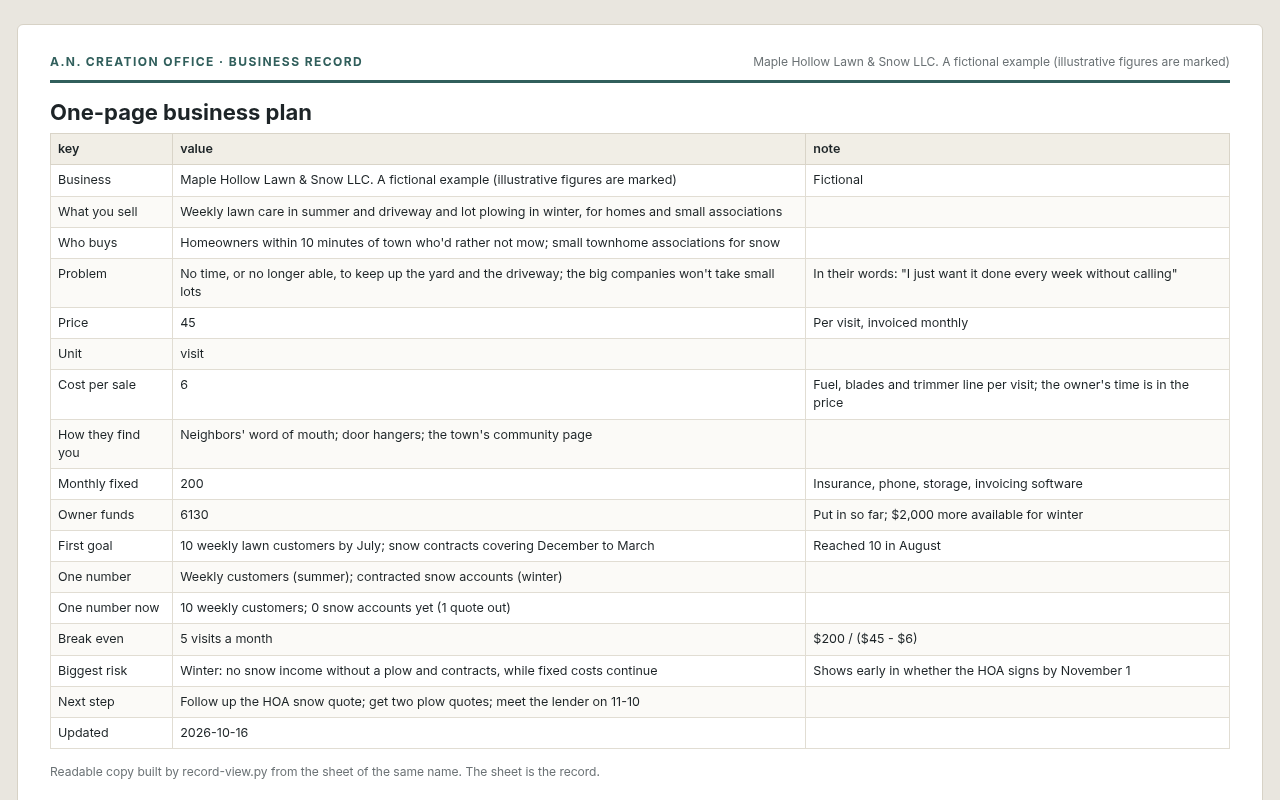
Pages from a worked example: a made-up one-owner lawn and snow business in its first season, with no invention. Figures marked illustrative aren't real. Open one to see the whole document, or see the full example. For the business around an invention, see the mousetrap example.
- One-page business plan. What you sell, to whom, at what price, what it costs to run, break-even, and the one number to watch.
- Invoices and getting paid. Numbered monthly invoices, Net 15, with the one overdue invoice flagged and a reminder drafted.
- Money each month. Sales, spending, cash and months of cash, computed from the invoices and the expense ledger.
- Lender packet. An equipment loan for a plow, checked against a season of real numbers.
What we learned
- Second scripted round: 9 of 21 checks passed. The fixes: one question per message, no fees or tax rates from memory, contractor-or-employee laid out without leaning either way, and the plan read back with "Did I get that right?" before it's saved.
- Third round: it asks each line of the business plan in its own message.
Methods this bot uses
These methods are explained in more depth at hotbotspot, a separate reference library on tools for bots.
- Write it down or it didn't happen
- Nothing ships without a yes
- Don't make it up
- Risk matrices and SWOT
- The current version at the point of use
Its sister bot
Inventing a product too? The Inventor's Project Manager takes an idea to a product that sells: design, prototypes, tooling and launch. The two share one folder.
Everything here is a starting point. Work with artificial intelligence always needs tuning, so test it and dial it in for your own work, data and model before you rely on it.